
The Guitar, Reimagined: Oklahoma’s Players, Makers, and Musical Innovators
From Western swing and jazz to acoustic experiments and stereo sound, Oklahoma musicians kept finding new possibilities in the guitar.
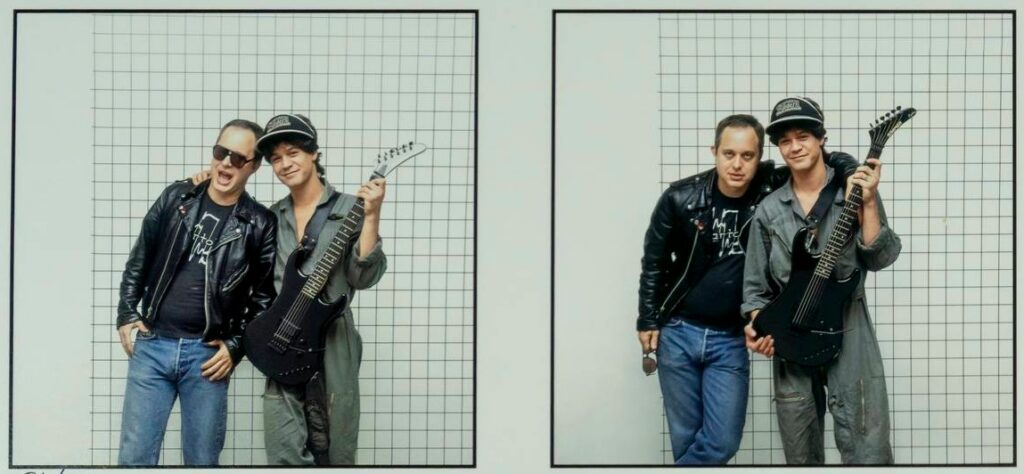
Steve Ripley and Eddie Van Halen. From the OKPOP Vault.
Steve Ripley had his head inside Leon Russell’s grand piano when he heard something he wanted to put inside a guitar.
Working as Russell’s recording engineer, Ripley was positioning microphones beneath the lid of a Steinway. With Russell playing, the sound surrounded him. Low notes here. High notes there. A whole instrument spread across space.
Back in the control room, Ripley could record drums, acoustic guitars, and organs in stereo. His electric guitar, meanwhile, sent its sound out of one speaker.
“I wanted to figure out something else to do to emulate that Steinway thing that I heard from Leon,” he recalled in an oral history preserved by OKPOP.
That wish eventually became a guitar whose individual strings could be placed across the stereo field. It would attract Eddie Van Halen and other adventurous players. But it began with someone listening closely enough to wonder whether an instrument could do more.
Oklahoma keeps appearing at moments when the guitar becomes something new: a solo voice that can stand beside a horn, a rhythm instrument that helps define funk, a piece of wood and wire redesigned around the person holding it. These changes happened through musicians working with bands, builders, and one another, often carrying Oklahoma experience far beyond the state.
First, make room for the guitar
Before anyone could explore where a guitar’s sound might go, there was a practical problem: getting it heard.
In a busy dance band, an acoustic guitar could struggle against horns and drums. Amplification let a guitarist step out of the rhythm section and carry a melody above the band.
An Oklahoma musician was already helping audiences encounter that possibility. Gage Brewer, who moved to Wichita in 1924, returned from California in 1932 with prototype electric guitars from the company that became Rickenbacker. That October, he introduced the instruments to Wichita audiences in performances widely recognized as a landmark in the electric guitar’s public debut.
Brewer’s contribution was to put a new invention in front of people and let them hear it work. A steel guitar and a standard, or “Spanish,” guitar offered different ways into this unfamiliar sound. Before the electric guitar could become a cultural icon, someone had to bring it onto a bandstand.
Braggs-born steel guitarist Bob Dunn seized that opportunity with Milton Brown’s Musical Brownies in Texas. His 1935 recordings helped establish electric steel guitar in country music. Drawing on his interest in jazz horns, Dunn made the instrument a forceful solo voice.
Charlie Christian carried that possibility into another musical world. Raised in Oklahoma City, he learned in the city’s Black musical community, including the clubs of Deep Deuce. By the time he joined Benny Goodman in 1939, he was developing an electric-guitar language built around flowing, single-note phrases.
The bar pickup in Christian’s guitars became so closely associated with him that it came to be known as the “Charlie Christian pickup.” Gibson’s Walter Fuller designed it; Christian made its sound famous.
Listen to “Seven Come Eleven.” The guitar steps forward with the confidence and flexibility of a horn. Christian’s flowing phrases helped establish electric guitar as an instrument capable of carrying the melodic conversation in jazz. For later players, that expanded the job: a guitarist could shape the direction of a performance through an individual solo voice.
Barney Kessel carried the conversation forward
In Muskogee, Barney Kessel was listening. Growing up around the city’s Black business and entertainment district, he encountered jazz and popular songs through local performances and movie theaters, where he worked as a ticket taker. Charlie Christian became a major influence on his playing.
As a teenager playing at the Oklahoma Club in Oklahoma City, Kessel looked into the audience and saw Christian himself. In a 1981 interview with Jas Obrecht, he recalled lending Christian his guitar to sit in, then spending time playing with him the following afternoon. His hero’s advice stayed with him: “No matter what else you do, get that feeling.”
Kessel went on to make a career in Southern California that stretched from jazz groups to recording studios. He played with musicians including Oscar Peterson, Lester Young, and Billie Holiday, while session work put him alongside artists such as the Beach Boys and Elvis Presley.
A listener might encounter Kessel on a jazz record, then hear him behind a pop singer without ever learning his name. Each session called for a different part: a solo, a chord beneath a voice, or an accompaniment that left another musician room to shine.
On a Western swing bandstand, a guitarist could shape an entire performance from the rhythm section. Eldon Shamblin made that position his own.
The work behind the gold guitar
In Tulsa, Eldon Shamblin’s moving bass lines and changing chords gave Bob Wills and His Texas Playboys both momentum and harmonic richness. From the rhythm section, he helped shape the whole arrangement.
At OKPOP, his 1954 gold Fender Stratocaster offers a tangible connection to that working life. Made during the Stratocaster’s debut year, it was among the earliest custom-color examples Fender produced for individual musicians, before those finishes became a regular option. Its finish is striking. The stories behind its wear are even better.
In her OKPOP interview, Rita Shamblin remembered her father patching his deteriorating guitar case with electrical tape. Eventually, friends at Guitar House gave him a replacement. She also recalled Leo Fender visiting performances, listening to the equipment, then working on her father’s guitar during a break.
On a bandstand, a guitar had to stay comfortable through a set and hold its place beside the other instruments. Rita’s memory of Fender working during a break puts those demands within earshot of the person who could change the equipment.
Fender’s approach also depended on feedback from working guitarists. Bill Carson’s complaints about a guitar’s sharp edge pressing into his ribs helped prompt the Stratocaster’s more comfortable, contoured design. An everyday irritation could become an improvement felt by generations of players.
OKPOP also preserves a Bill Carson reissue-model guitar, serial number 001, personally owned and played by Carson.
Rita described the habit underneath her father’s musicianship: “He always was studying something.” Music, piano tuning, electronics, even the car he was working on: there was always another thing to understand.
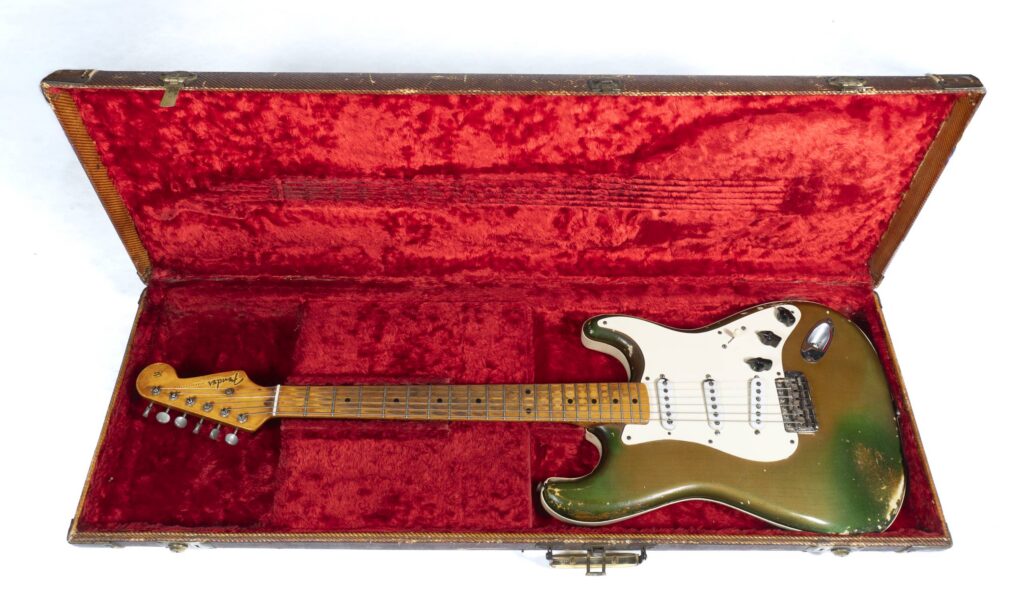
Eldon Shamblin’s 1954 gold Fender Stratocaster, preserved by OKPOP. Its worn finish records years of use by the Western swing guitarist. From the OKPOP Vault.
Steel strings, moving voices
Alongside those moving chords, steel guitar gave the band a voice that could slide between pitches, bend, and sing. Following Dunn’s early electric recordings, Oklahoma-born and Oklahoma-based players helped make that sound essential to Western swing and country music.
Leon McAuliffe joined the Tulsa-based Texas Playboys in 1935. His performance of “Steel Guitar Rag” helped make steel guitar a signature sound of Western swing. After the war, he returned to Tulsa and led his own band, the Cimarron Boys. OKPOP now preserves one of his instruments: a 1955 Fender four-neck Stringmaster in the custom color he called “Cimarron red.”
Oklahoma City’s Noel Boggs also brought steel guitar into the spotlight with Bob Wills and other Western swing bands. Fender built multi-neck steels for him, and Boggs’s family recalled conversations about sound and playability continuing from social gatherings into the workshop.
Duncan-born Ralph Mooney learned slide playing with a knife on a flat-top guitar, then built a steel guitar himself. His work with Wynn Stewart, Buck Owens, and Merle Haggard helped give the Bakersfield sound its distinctive bite. Later, his playing became an important part of Waylon Jennings’s music.
Speedy West’s Oklahoma connection came later in life. After making celebrated recordings with guitarist Jimmy Bryant, he moved to Tulsa to work for Fender and later lived in Broken Arrow. His adventurous steel playing crossed country, jazz, and popular music; his Fender work connected that experience to the instruments other musicians would use.
Steel’s sliding phrases shared the Western swing bandstand with a very different sound: the gritty attack of Junior Barnard’s guitar.
Junior Barnard found the rough edge
Coweta-born Junior Barnard grew up playing guitar behind his father’s fiddle at dances and house parties. He worked in Tulsa’s bands and radio studios before becoming one of the most adventurous guitar voices in Bob Wills’ musical world.
Where Shamblin’s moving chords gave the band a foundation, Barnard’s solos could make the whole performance sound more unruly. His playing had bite: quick runs, blues feeling, and a gritty, distorted tone that anticipated sounds later associated with rock guitar.
Listen to his work on “Brain Cloudy Blues” or “Fat Boy Rag.” The swing is unmistakable, but so is the roughness around the notes. These are 1940s performances, years before fuzz pedals became familiar tools.
That roughness is part of what makes Barnard sound startlingly familiar to ears raised on rock. Distortion would become central to much of electric guitar’s expressive vocabulary; here, decades earlier, a Western swing guitarist was already showing how an abrasive tone could intensify a solo. Barnard belongs in that larger history even when the music around him is filed under country.
Lowell Fulson carried Oklahoma west
For Lowell Fulson, the blues began close to home. Born in Tulsa and raised around Ada, he grew up hearing his grandfather’s violin and his uncles’ guitars. He played at church and picnics, then worked in local clubs as a teenager.
After military service, he moved to Oakland in 1946. On the West Coast, Fulson helped develop an urban blues sound that placed electric guitar alongside horns, bass, and drums. Oklahoma experience traveled with him into a new musical setting.
His songs traveled farther still. “Reconsider Baby,” released in 1954, became a blues standard recorded by Elvis Presley and Eric Clapton. Hear Fulson’s own version and follow the conversation between his singing and guitar: an instrumental phrase can answer a voice as clearly as another singer.
Among the young guitarists listening to Fulson was Oklahoma’s Jimmy Nolen. He would carry his own blues grounding into music built around an insistent rhythmic pulse.
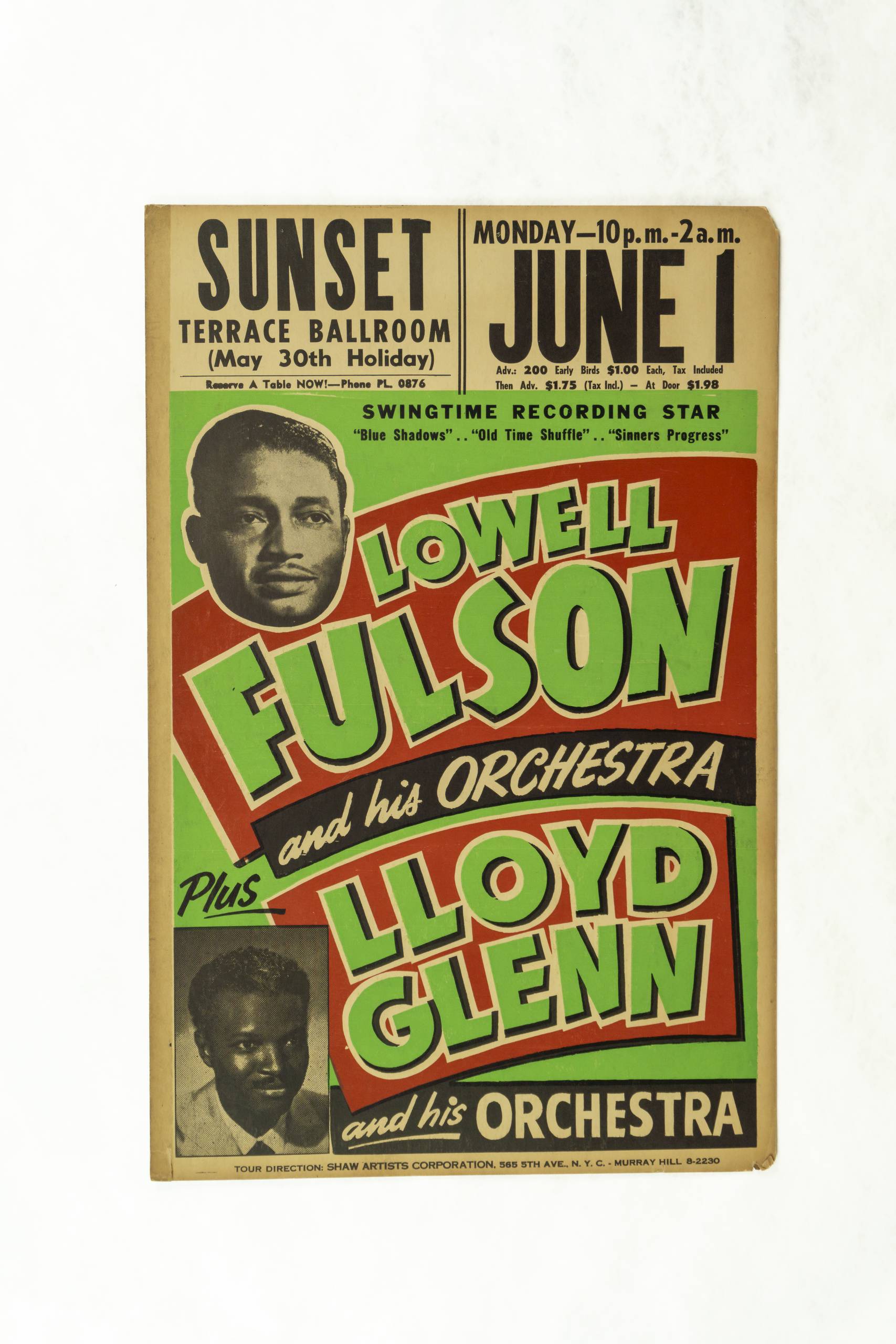
Lowell Fulson concert poster. From the OKPOP Vault.
A familiar instrument, a different job
For Oklahoma City-born Nolen, that journey began with blues heard over the radio. Later, in James Brown’s band, his guitar would function almost like another piece of the drum kit.
Raised on a farm near Wealaka, Nolen taught himself guitar while listening to players including Fulson and T-Bone Walker. With Brown, he helped establish the clipped, percussive approach often called “chicken scratch.” Short chords and carefully placed accents became essential parts of the groove.
Listen to “Papa’s Got a Brand New Bag” and pay attention to what the guitar does between the vocal lines. Its power comes from precision: how a note starts, how quickly it stops, where it lands. Nolen and his bandmates helped develop the rhythmic language of funk, giving later guitarists a model for making a small, repeated figure carry enormous energy.
Tulsa-born David T. Walker brought a lyrical touch to soul and popular music, including Marvin Gaye’s Let’s Get It On and Stevie Wonder’s Innervisions. His approach began with the person singing. “I always strived to deeply understand and feel what the artist was trying to convey,” he told Guitar World. From there, he shaped a guitar part around the song’s story. His session work with artists including the Jackson 5 and Carole King, alongside recordings under his own name, made that attentive touch part of a much wider musical world.
J.J. Cale made room inside the groove
Rhythm and restraint also mattered to Tulsa-raised J.J. Cale, though his music had a different feel. His relaxed delivery and fluid guitar playing helped define the Tulsa Sound. In his music, the guitar can seem to settle into a groove already in motion, contributing a short phrase and leaving room for the rhythm to answer.
His influence traveled through both his playing and his songwriting. Eric Clapton recorded “After Midnight” and “Cocaine,” while Lynyrd Skynyrd recorded “Call Me the Breeze.” Cale and Clapton eventually made an album together, The Road to Escondido. The relationship grew from one musician hearing something in another’s work that he wanted to understand more deeply.
Compare Cale’s “After Midnight” with Clapton’s version: a shared song can have a different gait, shaped by the touch and timing of the musicians playing it. Cale’s example makes a useful point for anyone learning guitar. The number of notes is only one choice. Their placement, weight, and the space around them can define a player just as clearly.
For Nokie Edwards, the feel of a guitar’s neck mattered as much as the sound coming from its strings.
Semie Moseley and Nokie Edwards: a guitar built to move
Oklahoma-born Nokie Edwards brought country roots and a restless ear to the Ventures. In his oral history, he remembered buying rock-and-roll singles to understand music that was initially unfamiliar to him. He listened, tried again, and began finding his way into it.
His relationship with Mosrite guitars also began with a practical request. He wanted a guitar neck trimmed down. That led him to builder Semie Moseley, who handed him an instrument to try. Edwards liked its feel and speed; the Ventures’ association with Mosrite followed.
Born in Durant, Mosrite co-founder Semie Moseley gave his instruments sculpted bodies and the quick, comfortable necks Edwards admired.
The Ventures model made that relationship visible: the band’s identity and Moseley’s design shared the same instrument. Instrumental rock put the guitar’s melody at the center of the listening experience, and the Ventures carried that approach to an international audience. Moseley’s instruments became part of its sound and image.
OKPOP preserves a candy-apple-red 1965 Mosrite Ventures II played by Edwards. Its carved body and narrow neck let us look closely at the choices behind the music. Here, two Oklahoma stories meet in one object: Moseley’s work as a maker and Edwards’s experience as a player.
Years later, Edwards developed his own HitchHiker guitar. Getting the features he wanted from other makers could be difficult, he explained, so he spent about two years trying bridges and pickups to find the response he wanted.
He also remembered a flash of inspiration while in Japan that sent him to work drawing out an idea. Beside the finished guitar, that memory offers another image of Edwards: a player setting down the instrument long enough to sketch what it might become.
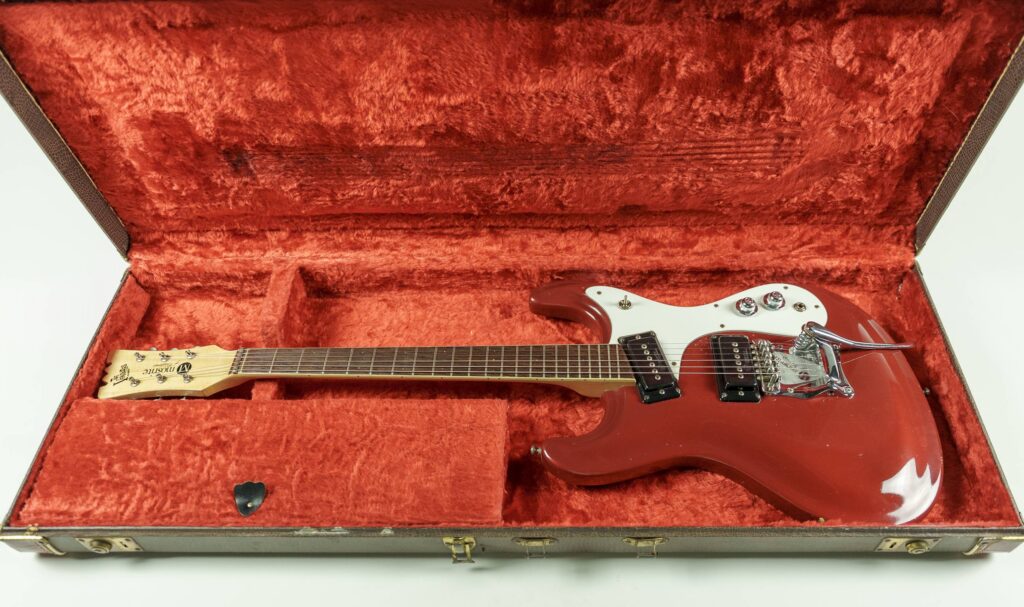
A 1965 Mosrite Ventures II played by Nokie Edwards, preserved by OKPOP, connects the guitarist’s story with Durant-born builder Semie Moseley. From the OKPOP Vault.
One guitar, several moving parts
With a steady bass beneath a moving melody, one guitarist could sound like several musicians playing together. Merle Travis made that approach so recognizable that fingerpickers around the world came to know it by his name.
Travis was born in Kentucky and learned from the fingerpicking tradition of Muhlenberg County, including players such as Mose Rager and Ike Everly. With his thumb supplying bass and accompaniment while his index finger picked the melody, he could make one instrument sound remarkably self-sufficient. His example helped shape later players, including Chet Atkins.
Oklahoma became part of Travis’s life in his later years, when he settled in the eastern part of the state. His place in this story reflects that adopted home; the roots of “Travis picking” remain firmly in Kentucky. Musical ideas cross state lines with the people who carry them.
Tulsa’s Tommy Crook found his own way to handle bass and melody on one instrument: he fitted his guitar with two bass strings. With electronic drums supplying the beat, he worked for decades as a one-man band. The arrangement also presented a challenge. As he explained in a 2013 interview published by Tulsa Jazz, he had only four guitar strings left for the rest of the music; taking off on a single-note run could mean losing the melody or accompaniment he was responsible for carrying.
Crook built much of that career close to home. His playing at the Inkwell Club caught the attention of Chet Atkins, who praised him on The Tonight Show. While many of his musical peers headed to California, Tulsa audiences could hear him in a hotel lounge.
Mason Williams brought “Classical Gas” into the living room
Mason Williams remembered a party where the guitar kept passing around a circle of remarkable players. He had gone with Roger Miller; Duane Eddy and Thumbs Carllile were among the musicians there. In his OKPOP oral history, Williams recalled deciding he needed something of his own ready for the next gathering.
“Okay, next party, I’m going to have something to play.”
That impulse helped set “Classical Gas” in motion. Released in 1968, the recording put acoustic guitar at the center of a dramatic orchestral arrangement. A piece Williams wanted to play among friends found a much larger audience.
Williams’s musical life had grown partly in Oklahoma. He graduated from Northwest Classen High School in Oklahoma City, attended Oklahoma City University, and played the state’s folk and coffeehouse circuit. Those experiences were part of a career that also included writing for The Smothers Brothers Comedy Hour.
Williams also brought what he had learned in music school to the piece. In his OKPOP interview, he compared the arrangement’s growing layers to a cake: the guitar and rhythm section establish the music before the strings add something new. Listen for the way the guitar sets its own momentum before the larger arrangement opens around it. Even as the sound grows, the guitar keeps telling the story.
Michael Hedges heard an orchestra in the wood
Enid-raised Michael Hedges explored a different way for one guitar to fill a room. While studying at Phillips University with mentor E. J. Ulrich, he experimented with altered tunings and unconventional techniques. His early composition “Silent Anticipations” already combined tapping across the strings with percussion on the guitar’s body.
Those experiments served the music he wanted to compose. A different tuning changed the relationships between the strings. Tapping offered another way to sound notes, and a strike against the body could become part of the rhythm. Melody, bass, and percussion could emerge from the same instrument in one performance.
Watch Hedges perform “Aerial Boundaries.” The movement of his hands helps explain sounds that can be difficult to picture from a recording alone. His work expanded the vocabulary of solo acoustic guitar, offering later players a way to think about the whole instrument as a source of sound.
Hedges could make an acoustic guitar seem to hold several voices at once. Steve Ripley wanted to give the guitar’s voices places of their own, spread across the space between speakers.
Six strings, a wider world
For Steve Ripley, the question reached beyond the guitar’s shape to where its sound could go. Returning to the spread of notes he had heard inside Leon Russell’s piano, he worked with steel guitarist and inventor Red Rhodes, who made a pickup system that separated the six strings into individual channels. Ripley initially played through six amplifiers.
That was a lot of equipment for one guitar.
When he got the opportunity to play with Bob Dylan, Ripley found a more portable approach: a small mixer that let him position each string between two amplifiers. Later, he incorporated those controls into the guitar itself. Van Halen became an enthusiastic supporter, and a Kramer Ripley stereo model brought the idea to more players.
For a listener, the result could be a chord spread between two speakers, its strings occupying different positions. For the player, deciding where those strings belonged became another musical choice, alongside which notes to play.
OKPOP’s collection includes a Ripley stereo guitar, preserving an instrument that gave players control over where each string could be heard.
Charlene Ripley remembered how much Steve had to learn to make it happen. He studied, read books, and asked questions as he worked out how to build the guitar he imagined.
She was part of that work, helping build and deliver guitars and keeping things moving. “I felt like we were a team,” she said.
Their son Elvis remembered another side of his father’s inventiveness: helping people repair used Ripley guitars years after the instruments had changed hands. Steve would pull out old notes and help someone bring a guitar back to life.
Long after a guitar left his hands, Ripley was still helping someone play it. The drawings, phone calls, and explanations became part of the instrument’s working life.
There is still room for another idea
Tulsa-born Annie Clark, known as St. Vincent, began her signature guitar for Ernie Ball Music Man with an angular sketch. The design took shape around her playing, comfort, and visual imagination.
According to the company’s account, the collaboration involved about 20 prototypes as the team refined balance, size, electronics, and tone. Clark’s design makes a familiar question newly visible: whose body, playing style, and imagination does a guitar accommodate? An instrument built around a different set of answers can invite players to reconsider what feels possible for them.
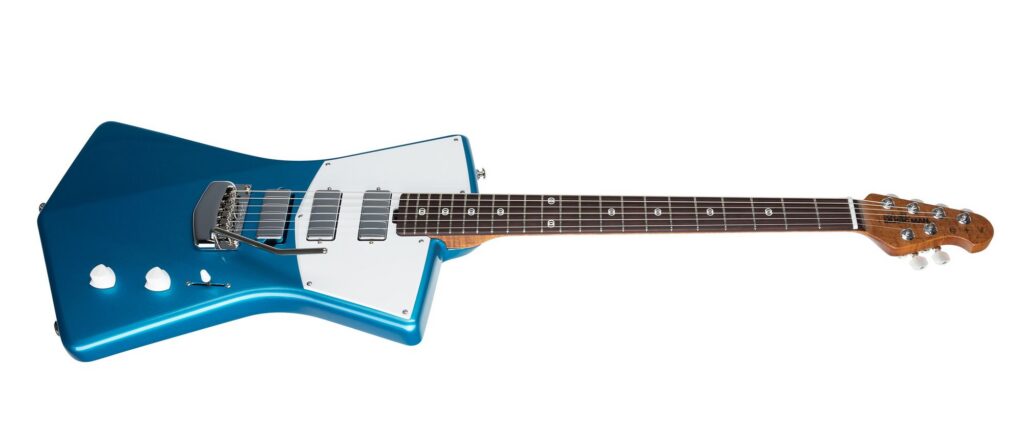
The St. Vincent signature guitar. Photo courtesy of Ernie Ball Music Man.
Stephen Egerton, the Descendents and ALL guitarist who made Tulsa his home, pairs a forceful rhythmic attack with melodic lines and unexpected chord changes. In a Premier Guitar interview, he described building music from three-note chords and melodies, drawing some of his harmonic ideas from fusion. That musical range sits behind a remarkably spare instrument: his Ernie Ball Music Man Stephen Egerton StingRay Artist Series guitar has no knobs or switches. He varies his picking attack to change the dynamics, putting much of that control directly in his hands.
At OKPOP, instruments and oral histories preserve different parts of the same working life. Shamblin’s gold guitar carries the wear of years of playing. Rita’s memories bring us the taped-up case, the repairs between sets, and the man who never stopped studying.
Return to Ripley with his head inside Leon’s piano. He was listening as a recording engineer and imagining what that experience could offer him as a guitarist. Somewhere between the sound he heard and the guitar he had, there was work to do. That space is still open.
Keep exploring
Start a listening journey with Bob Dunn and Milton Brown’s Musical Brownies’ “Taking Off,” the Benny Goodman Sextet’s “Seven Come Eleven,” Bob Wills and His Texas Playboys’ “Take Me Back to Tulsa,” James Brown’s “Papa’s Got a Brand New Bag,” and J.J. Cale’s “After Midnight.” Listen for the guitar’s changing role: solo voice, moving foundation, rhythmic engine, and room to breathe.
Extend the listening journey with McAuliffe’s “Steel Guitar Rag,” recordings by Speedy West and Jimmy Bryant, Merle Travis’s “Cannonball Rag,” Mason Williams’s original “Classical Gas,” and Michael Hedges’s “Aerial Boundaries.” With Travis and Hedges, a filmed performance is especially revealing: watch how one player keeps several musical ideas moving at once.
Read more through the Oklahoma Historical Society’s profiles of Bob Dunn, Charlie Christian, Eldon Shamblin, and Jimmy Nolen, and explore Ernie Ball Music Man’s account of the St. Vincent design.
Explore Gage Brewer’s 1932 demonstrations through the Wichita-Sedgwick County Historical Museum director’s history of the electric guitar; hear more about Junior Barnard through Guitar Player’s retrospective; read OHS’s Lowell Fulson profile; and see OKPOP’s story about the Edwards Mosrite acquisition. Add “Brain Cloudy Blues,” “Fat Boy Rag,” and Fulson’s “Reconsider Baby” to the listening journey.
